
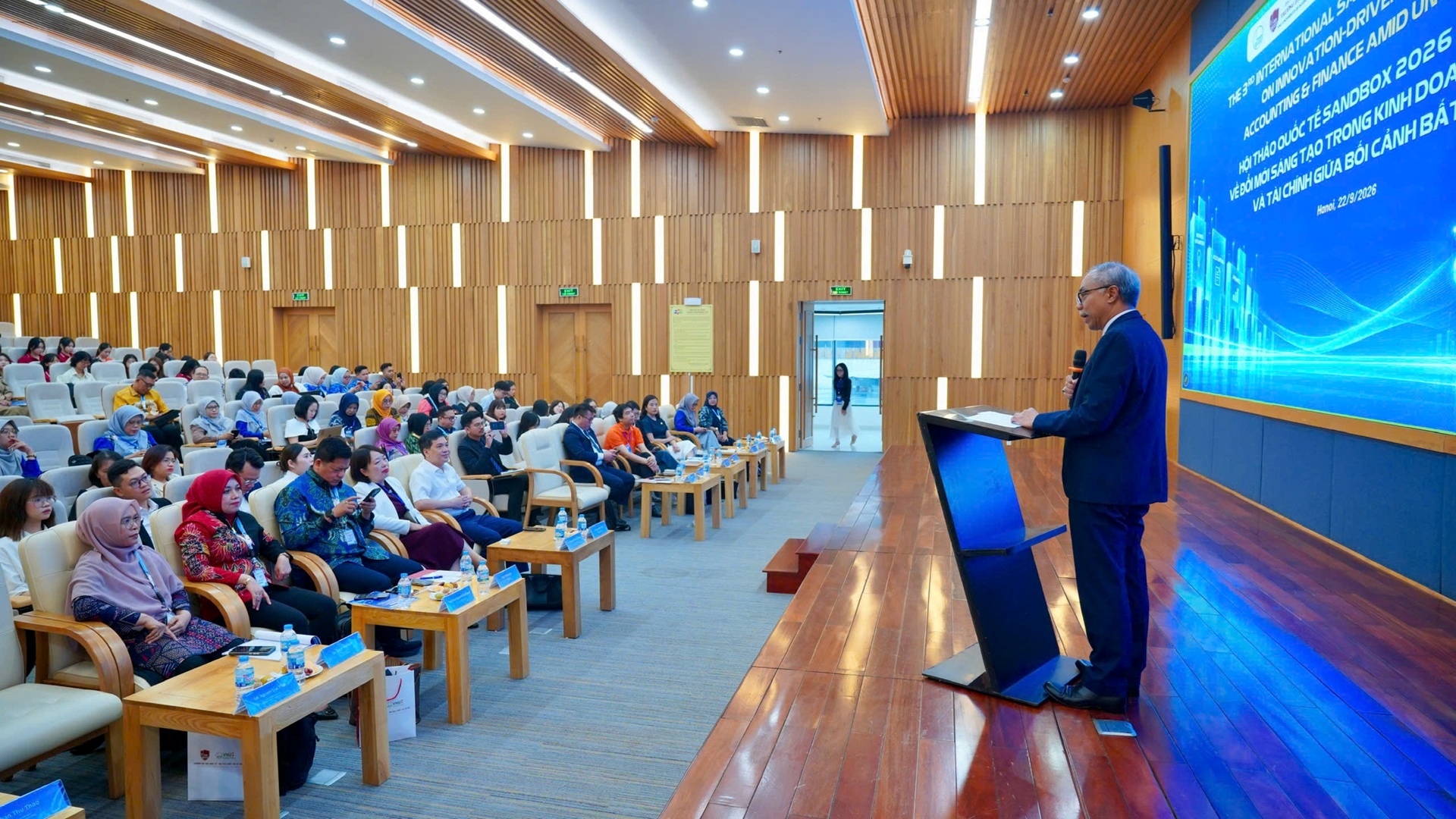
The third SANDBOX International Conference 2026, themed “Innovation-driven Business, Accounting & Finance amid Uncertainty,” was held on September 22, 2026.
The conference was jointly organized by VNU University of Economics and Business, (VNU-UEB), Rangsit University (Thailand), the Forum on Management and Economic Accounting (FAME, Indonesia), FPT Corporation (Vietnam), CFO Vietnam and Politeknik Negeri Malang (Indonesia).
From technology adoption to responsible value creation
Speaking at the conference, Prof.Dr. Tran Thi Thanh Tu, Director of VNU Department of Science and Innovation and Director ofVNU Science and Technology Development Fund said that AI, digital technologies, new business models and shifts in global value chains are transforming the way economies operate, businesses compete and universities prepare future generations.
 |
For Vietnam and the ASEAN region, she noted, digital transformation is no longer simply a means of improving efficiency. It has become an important foundation for productivity, competitiveness, adaptability and sustainable growth.
Technology alone, however, does not guarantee successful transformation. An impressive AI application does not automatically generate business value. More data does not necessarily lead to better decisions, while the use of AI in education does not automatically result in better learning outcomes.
Prof.Dr. Tran Thi Thanh Tu highlighted five priorities for turning technology into sustainable, measurable and responsible value: moving from technology-driven experimentation to value-driven innovation; using AI to augment human capabilities; transforming human resource development for the digital economy; building innovation on trust and responsible governance; and strengthening collaboration among universities, businesses, government agencies and international partners.
Rather than simply asking, “Can AI do this?”, organizations should ask, “Can AI create real, measurable and scalable value?”, she said.
The effectiveness of digital transformation should therefore be assessed by its impact on productivity, decision-making quality, cost efficiency, risk management and value-creation capabilities, rather than merely by the number of technologies adopted.
Sandbox mechanisms help bridge the gap between AI and practice
 |
Indonesian Ambassador to Vietnam Adam Mulawarman Tugio said that while AI offers opportunities to improve productivity and support decision-making, its adoption also raises challenges related to data quality, transparency, algorithmic bias, cybersecurity and accountability.
The key question, therefore, is not whether AI creates an impact, but how its benefits can be harnessed while risks are managed responsibly.
“This is why the sandbox model, or controlled testing mechanism, is important,” Ambassador Adam Mulawarman Tugio said. Such mechanisms allow businesses to test technologies under regulatory supervision, helping policymakers develop regulations based on practical evidence rather than theory alone.
He also stressed that education needs to keep pace with the rapid development of AI. Training programmes should incorporate knowledge of data, machine learning, AI governance, cybersecurity and ethics, while strengthening interdisciplinary connections among accounting, finance and technology.
Learners, he noted, need not only to understand how to use AI, but also to recognize when they should not rely on technology.
The conference also provided a platform for expanding academic and professional partnerships. The Faculty of Accounting and Auditing at VNU University of Economics and Business signed memoranda of understanding with 17 Indonesian universities and professional associations.
The agreements are expected to promote exchanges and cooperation in scientific research and teaching, while strengthening links among universities, professional organizations and businesses.
 |
 |


