
 |
A Global Forum for Dialogue on Internationalisation and Sustainability
As higher education institutions worldwide navigate rapid technological change, increasing demands for sustainability, and evolving models of international cooperation, ICIS2026 created a valuable space for dialogue on how universities can respond to these challenges while contributing to sustainable development.
The conference welcomed participants from Vietnam, Japan, Germany, Australia, Indonesia, India, South Africa, the Philippines, the United States, and other countries, fostering meaningful exchanges across cultures, disciplines, and institutional contexts.
 |
A key highlight of ICIS2026 was the participation of internationally renowned scholars whose keynote presentations provided strategic insights into the future of higher education. Among them was Professor Joan DeJaeghere from the University of Minnesota (USA), a leading scholar in comparative and international education. Her keynote emphasized the role of global education research and leadership in advancing the global commons and building equitable international partnerships.
Professor Tran Thi Ly from Deakin University (Australia), one of The PIE’s Top 50 Voices in International Education, explored how higher education research can generate meaningful impact on student success, social equity, and sustainable development outcomes.
Professor Stefanie Sauer from EHB (Germany) contributed European perspectives on sustainable higher education development, emphasizing the importance of international cooperation, institutional innovation, and cross-cultural engagement in addressing contemporary global challenges.
Meanwhile, Professor Hiroshi Ota from Hitotsubashi University (Japan), a prominent expert in higher education internationalisation and student mobility, shared perspectives on global learning, international education leadership, and strategies for cultivating globally competent graduates.
Together, these keynote sessions encouraged participants to rethink conventional approaches to internationalisation and consider how universities can foster more inclusive, ethical, and sustainable forms of global engagement. Their presentations set the tone for broader discussions throughout the conference, highlighting the importance of collaboration, mutual learning, and responsible leadership in shaping the future of higher education.
New Ideas, New Voices
Building on the keynote discussions, ICIS2026 featured approximately 40 academic presentations organized around five thematic clusters:
- Leadership and Policy in Internationalisation and Sustainability Education;
- Internationalised Curriculum and Global Learning in Higher Education;
- Mobility, Exchange, and Inclusive Access;
- Global Partnerships, Research, and Collaboration;
- Innovation, Ethics, and Sustainability in Internationalisation.
 |
Covering topics from higher education governance and student mobility to sustainability and international research collaboration, the sessions fostered meaningful exchanges of ideas and opened new opportunities for interdisciplinary and cross-border partnerships.
Reflecting the conference’s commitment to nurturing future academic leaders, ICIS2026 recognized outstanding young researchers through its Best Oral Presentation Awards. Among the awardees, MA. Nguyen Thi Thuy Dung (VNU Vietnam Japan University, Vietnam) presented a study on the impact of the Sakura Science Exchange Program, demonstrating how international exchange experiences contribute to students’ cultural awareness, personal growth, and career aspirations. PhD Candidate Nguyen Thanh Phuong (The University of Tokyo, Japan) was recognized for research examining the relationship between regionalisation and sustainability in Vietnam’s higher education sector, offering insights into how regional governance frameworks shape universities’ approaches to sustainable development.
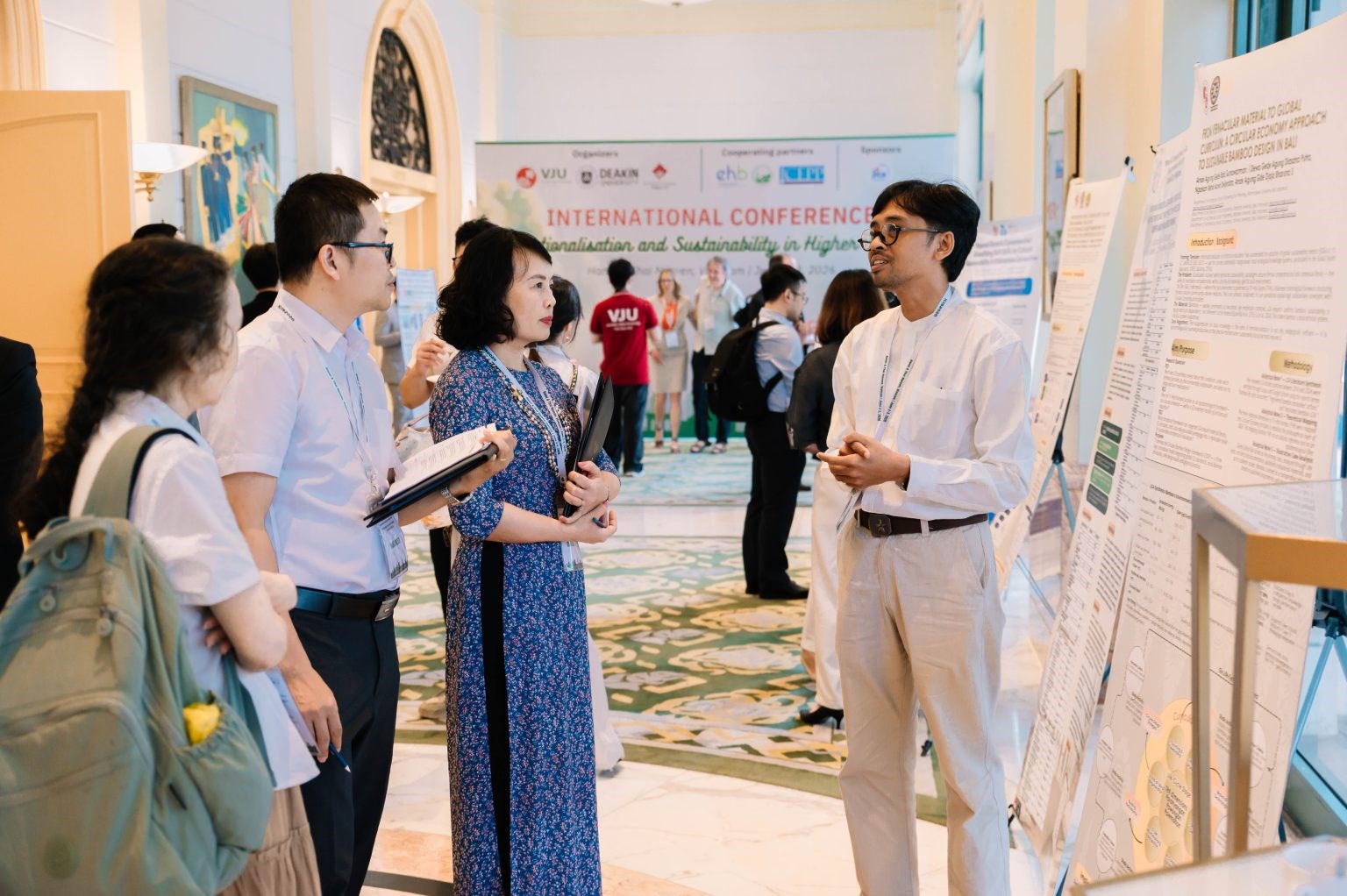
ICIS2026 also highlighted outstanding poster presentations through two Best Poster Awards.
One award was presented to researchers from Warmadewa University and Udayana University (Indonesia) for From Vernacular Material to Global Curriculum: A Circular Economy Approach to Sustainable Bamboo Design in Bali. The project demonstrated how local knowledge and sustainable design principles can be integrated into higher education curricula. Another award went to researchers from Ngurah Rai University and Udayana University (Indonesia) for Reframing Sustainable Architecture Education through Tropical Thermal Comfort: Integrating Green Building Research into Global Learning Frameworks. Their work highlighted innovative approaches to sustainability education within architecture and environmental design.
Beyond the Conference Hall: Building Connections for the Future
Beyond the formal academic program, ICIS2026 offered participants opportunities to experience sustainability in practice through field-based learning and cultural exchange activities in Thai Nguyen Province.
Delegates visited the Climate Learning Center at TUAF, where they engaged in immersive activities designed to deepen understanding of environmental sustainability through direct interaction with nature. Participants also explored the production process behind Thai Nguyen’s renowned tea industry, gaining insights into traditional cultivation methods and sustainable agricultural practices. Another memorable highlight was the visit to Thai Hai Village, a community-based cultural tourism destination recognized by UN Tourism. There, delegates learned about local traditions, community-led development, and efforts to preserve indigenous cultural heritage while promoting sustainable livelihoods.
 |
Despite the intense summer heat, participants enthusiastically embraced these outdoor activities. The field visits complemented the academic discussions by demonstrating how sustainability can be translated from policy frameworks and theoretical concepts into tangible practices within communities and local environments.
More importantly, ICIS2026 was not only a venue for presenting research. It was a space for building relationships, fostering mutual understanding, and creating opportunities for future collaboration across borders. Throughout the conference, conversations extended beyond keynote sessions and panel discussions to networking events, informal exchanges, and field visits. Scholars and practitioners explored possibilities for joint research projects, academic mobility initiatives, institutional partnerships, and future collaborative activities.


